
![Golang Methods Tutorial [Practical Examples]](/golang-methods/golang_methods.jpg)
Introduction to Golang Methods
Go methods are basically functions with receiver arguments between
thefunckeyword and the name of the method. The receiver does appear
in its own argument list. Go uses receivers to implement object
orientation just like other languages do like python and Java where
classes are used to achieve object orientation. Go does not have
classes, but you can define methods on different types like struct, and
non-struct types.
In Go and many other programming languages , methods are used to expose and hide properties of a type, and therefore with the help of receiver arguments , methods are used to hide and access the properties of a type.
Methods syntax
The unique thing about the above syntax is that the receiver type appears in its argument list. The receiver type declares the type the function is going to be attached to. One important thing to note is that the method and the receiver have to be in the same package. This means that Go does not allow us to declare a method and receiver whose type is defined in another package and this rule applies to built in types such as int andstring.
func (receiverName receiverType) methodName (parameter List)(returnTypes){
 <em>  method body</em>
}
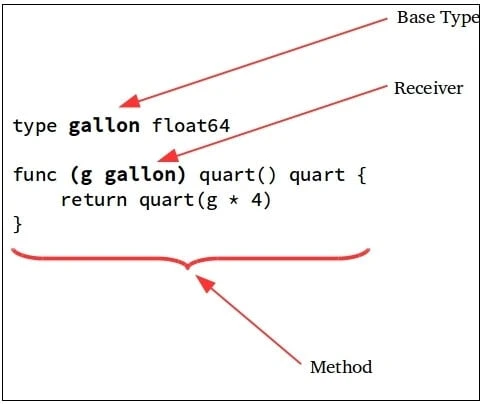
The following figure highlights the different parts involved in defining a method. It shows the quart method attached to the type gallon based receiver via the g gallon receiver parameter:
Using Method with struct type receivers
In Go, you can define a method whose receiver is a struct or a non-struct type. For most of the examples in this article, structs will be used to demonstrate methods in Go. If you haven’t already, install Go runtime, and create a working directory and add main.go file in your working directory to start writing Go methods.
Example
package main

import "fmt"

type User struct {
   Name  string
   Email string
}

func (u User) userDetails() string {
   return fmt.Sprintf("User name is :%s and email is: %s", u.Name, u.Email)
}

func main() {
   user1 := User{Name: "John Doe", Email: "johndoe@golinuxcloud.com"}
   fmt.Println(user1.userDetails())
}
Explanation
In the preceding example, we have created aUserstruct,
withNameandEmailattributes. We then define a method
calleduserDetails(), with theUserstruct as the receiver
indicated by (u User). In theuserDetails()method, we now have
access to the receiver via theureceiver name. We use the dot
notation to access the receiver attributes and methods like
sou.Nameoru.Email. In the main function, we create an instance of
theUserstruct, and print the details of the user on the screen by
calling theuserDetails()method on theuser1instance.
Output
$ go run main.go
User name is :John Doe and email is: johndoe@golinuxcloud.com
Using Methods with non-struct receivers
In the preceding example, we defined methods with struct types. It is possible to define methods with other types that are not struct types. One important thing to note though is that when defining a method on a type, the definition of the receiver type and of the method should be in the same package.
Example
package main

import "fmt"

type myNumber int

func (num myNumber) square() myNumber {
   if num == 0 {
       return 1
   }
   return num * num
}

func main() {
   num := myNumber(25)
   sq := num.square()
   fmt.Printf("The square of %d is %d \n", num, sq)
}
Output
$ go run main.go
The square of 25 is 625
Using Methods with interface types
An interface in Go is a type with a defined method signature. Types with these methods defined in the interface implement the interface implicitly. With interfaces, the methods are defined both in the interface and the receiver as shown below.
Example
package main

import "fmt"

var URL string

type Protocal interface {
   request(URLEndpoint string)
   response() string
}
type HTTPProtocol struct {
   URL string
}

func (HTTP *HTTPProtocol) request(URLEndpoint string) {
   URL = fmt.Sprintf("%s/%s", HTTP.URL, URLEndpoint)
   HTTP.URL = URL
}
func (http HTTPProtocol) response() string {
   return URL
}
func main() {
   HTTPP := HTTPProtocol{URL: "https://www.golinuxcloud.com"}
   HTTPP.request("go-methods")
   res := HTTPP.response()
   fmt.Println(res)
   fmt.Println(HTTPP)
}
Explanation
In this example, we are trying to mimic request response client server
architecture. We first declare aURLstring type at the top.Then we
define aProtocolinterface with two methods
namelyrequest()andresponse(). At this point, if we have a type
with these methods defined, that type will implement
ourProtocolinterface implicitly. Then we define
aHTTPProtocolstruct type withrequest()andresponse()methods.
Therequest()method has a pointer receiver, and that allows us to
modify theURLattribute of theHTTPProtocolstruct. We also assign
theURLstring type variable to the new URL. In the main function, we
create an instance of theHTTPProtocolstruct (HTTPP) with a URL
string. We then use therequest()method to pass the URL
endpoint(“go-methods”), which goes ahead to effect the changes both on
theURLvariable and theURLattribute of
theHTTPProtocolinstance.
Output
$ go run main.go
https://www.golinuxcloud.com/methods
{https://www.golinuxcloud.com/methods}
Using Methods with value and pointer receivers
Go methods can accept both value and pointer receivers. In our previous example we used value receivers, in this section , we will work with both. A pointer in Go is a variable used to store the memory address of another variable, in this case we will use a pointer as a receiver. Go always passes by value , which means it creates a copy of the value in the function. If you call a method with a value receiver, and the method modifies that value, the caller will not see that modification made to the value. If you want to modify the value, the receiver has to be a pointer. In simple terms, we use pointer receivers in methods to modify the value the receiver points to and to avoid copying the value on each method call.
Learn more about pointers: Go Pointers Explained for Beginners [Practical Examples].
Example
package main

import "fmt"

type User struct {
   Name  string
   Email string
}

func (u User) userDetails() string {
   return fmt.Sprintf("User name is :%s and email is: %s", u.Name, u.Email)
}

func (u *User) changeDetails(newName, newEmail string) {
   u.Name = newName
   u.Email = newEmail
}

func main() {
   user1 := User{Name: "John Doe", Email: "johndoe@golinuxcloud.com"}
   fmt.Println(user1.userDetails())
   user1.changeDetails("Mary Doe", "marydoe@golinuxcloud.com")
   fmt.Println(user1.userDetails())
}
Explanation
In the above example, we add a new method calledchangeDetails()with
a pointer receiver to the User struct type and anewNameof type
string in the parameter list. We then use the dot notation to get access
to the receiver’s name and email attribute and change it to
thenewNameandnewEmailstring respectively. In the main function,
we instantiate a new user(user1) with a name and an email. We then call
thechangeDetails()function on theuser1instance , which modifies
the name and email to whatever name and email we pass to
thechangeDetails()method. When this code is executed, we notice that
the name and email of theuser1changes to a new name and email
courtesy of thechangeDetails()method.
Output
$ go run main.go
User name is :John Doe and email is: johndoe@golinuxcloud.com
User name is :Mary Doe and email is: marydoe@golinuxcloud.com
Summary
In this tutorial, we have learned about what methods are and what is the difference between a method and a function. We have also dived deep into the relationship between methods, receivers and interfaces. Go methods and interfaces are important features of Go that every Go developer should have at their fingertips.