

If you see the error “zsh: command not found: pip” on macOS, it
usually means pip is installed as pip3 or is not available in your PATH.
Quick fix (try this first)
python3 -m pip install --upgrade pip
This quick fix works in most cases.
On macOS, pip is often installed as pip3, which is why the pip
command is not found in zsh. If it doesn’t resolve the issue, follow the
additional fixes below based on your Python setup.
What causes “zsh: command not found: pip” on macOS?
You typically see this error for one of the following reasons:
pipis installed as pip3, notpippipexists but is not in PATH- Python was installed without pip
- A virtual environment is not activated
- Python installation is incomplete or broken
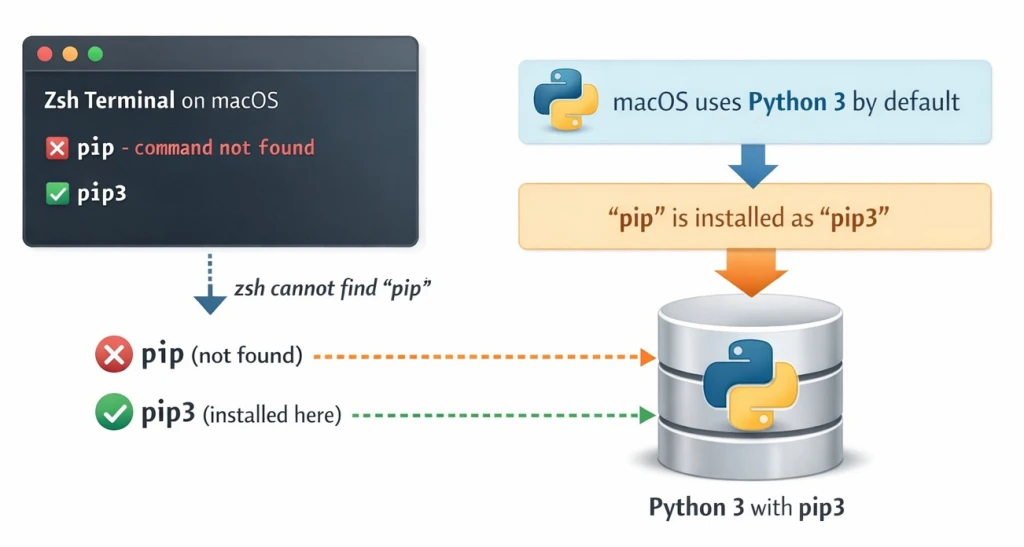
Fix 1: Use pip3 instead of pip (Most Common)
On macOS, Python 3 is the default and pip is installed as pip3.
pip3 --version
If this works, you can install packages like this:
pip3 install requests
Or use the safest method:
python3 -m pip install requests
This avoids PATH and shell issues completely.
Fix 2: Install pip on macOS using get-pip.py
If pip is not installed at all, install it manually.
Download the installer:
curl https://bootstrap.pypa.io/get-pip.py -o get-pip.py
Run it using Python 3:
python3 get-pip.py
Verify installation:
pip3 --version
Python 3 must already be installed for this method.
Fix 3: Add pip to PATH in zsh (macOS)
Sometimes pip exists but zsh cannot find it.
Check your PATH:
echo $PATH
Find pip and python paths:
which pip3
which python3
Common pip locations on macOS:
/usr/local/bin/Library/Frameworks/Python.framework/Versions/3.x/bin
Edit your zsh config:
nano ~/.zshrc
Add (adjust paths if required):
export PATH="/usr/local/bin:/Library/Frameworks/Python.framework/Versions/3.x/bin:$PATH"
Apply changes:
source ~/.zshrc
Verify:
pip3 --version
Fix 4: Reinstall pip using Homebrew (Recommended)
If you want the cleanest and safest setup, use Homebrew.
Install Homebrew (if not installed):
/bin/bash -c "$(curl -fsSL https://raw.githubusercontent.com/Homebrew/install/HEAD/install.sh)"
Install Python (includes pip):
brew install python
Verify:
python3 --version
pip3 --version
Homebrew manages PATH automatically, avoiding most zsh issues.
Fix 5: pip not found inside a virtual environment
Each virtual environment has its own pip.
Activate your virtual environment:
source /path/to/venv/bin/activate
Check pip:
pip --version
If pip is missing inside the environment, install it:
python -m ensurepip --upgrade
Or using get-pip.py:
curl https://bootstrap.pypa.io/get-pip.py -o get-pip.py
python get-pip.py
Which fix should you use?
- New macOS user → Fix 4 (Homebrew)
- pip3 works but pip fails → Fix 1
- pip installed but not found → Fix 3 (PATH)
- Virtual environment issue → Fix 5
- pip completely missing → Fix 2
Verify the fix
After applying any fix, confirm:
pip3 --version
python3 -m pip --version
If these commands work, the error is resolved.
Why macOS shows this error so often
- macOS ships with zsh as default shell
- Python 2 is deprecated
pipbinary is no longer created by default- Python frameworks install pip outside default PATH
Using python3 -m pip avoids all of these problems.
Final recommendation
For long-term stability on macOS, always use:
python3 -m pip install <package>
This works across:
- zsh
- Homebrew Python
- system Python
- virtual environments
Summary
On macOS, the “zsh: command not found: pip” error usually occurs
because pip is installed as pip3 or is missing from the PATH. Using
python3 -m pip works reliably across system Python, Homebrew, and
virtual environments. If the quick fix fails, reinstalling Python with
Homebrew or fixing PATH resolves the issue.
References
- Official pip installation guide – Python Packaging Authority
- Python package installation documentation – Python.org