
“If” can be understood as metaphorical English “what if”
which most people use in their day to day life. What if this doesn’t
happen? If this car doesn’t start, use the other one. We are loaded
with numerous examples from across the globe on usage of if. Decision
making is one of the most basic requirement of any kind of programming
language. Majority of the programming languages have control statements
and you will find majority of them use the keyword if in their control
statements.
In python we can use if..elif..else statement for such conditional
checks. So in this tutorial we will learn about python if else statement
along with their respective syntax using multiple examples.
What is indentation? Why is it important?
- You must be familiar with the term “indentation” before we go ahead.
- Indentation is one of Python’s singular features and is used everywhere in Python.
- Python uses indentation to determine how a line, or group of lines, is related to the rest of the program.
- Basically, it uses whitespace to force you to write neatly formatted code with a clear visual structure.
- One of the advantage here is readability. It’s clearer and easier to read code when it all shares the same indentation, meaning the block of code belongs to the same branch.
- If the indentation is not followed properly then you may get an
“
IndentationError” error. - Unlike some of the other programming language we do not have a closing
function for the
if block. - For example in perl we use
{}curly braces to define the start and end of the block, in shell we use “fi” to end the block. - So indentation is important, anything under this “
if condition:” block which starts with indentation would be part of thatifstatement.
Python if statement
With python if statement we can only check for single condition only.
Syntax
The syntax to use python if statement would be:
if condition:
    statements-1
- Here we have a single conditional check and if the condition returns
Truethen thestatements-1will be executed. - If the condition returns
Falsethen theif blockwill be ignored Truevalue means zero exit status whileFalseboolean value means non-zero exit status.- There is no way to define an end of
if block, you must put all theif blockstatements under same indentation
For example:
if condition:
   statements-1
   statements-2
   statements-3
Here as you observe, all the statements under the if block are
following the same indentation value. In this example, statements-3
will be considered outside the if block and will be executed
irrespective of the if condition Return value.
if condition:
   statements-1
   statements-2
statements-3
Flowchart
This flowchart will give you a graphical representation of the syntax value:
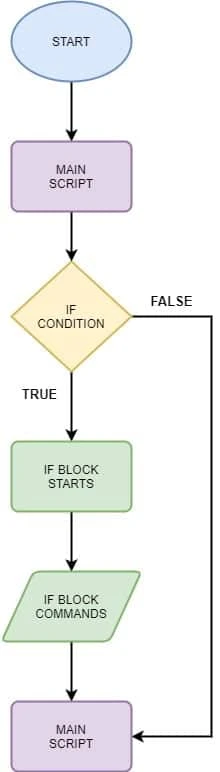
Python if statement
Python Script Example
In this example we will ask user to provide any integer value. For now
if you are not familiar with try and except, you can ignore that
function. We have added that to make sure, user is allowed to enter only
integers.
ifcondition will check if the provided number is greater than 5.- If this comparison returns
True, i.e. provided number is greater than 5 then the script will enter theif block - If the provided number is less than 5, then the condition will return
Falsehence theif blockwill not be executed - I am using
print()to help you understand the content ofif block, observe the indentation. All the statements in theif blockare having the same indentation - The last
printstatement i.e. “Now we are in main function” will be called irrespective of the condition value because it is called outside theif block
#!/usr/bin/env python3

import sys

# Only integers allowed
try:
    num = int(input("Enter any number: "))
except:
    print("Only numbers allowed")
    sys.exit(1)

# if block condition
if num > 5:
    # if block starts, notice the indentation
    print("You have entered the if block")
    print("The provided number is greater than 5")
    print("Exiting if block")

# if block ends, notice the indentation
print("Now we are in main function")
Output (if condition returns True):
# python3 /tmp/if_else_example.py
Enter any number between 1-10: 6
You have entered the if block
The provided number is greater than 5
Exiting if block
Now we are in main function
Output (if condition returns False):
# python3 /tmp/if_else_example.py
Enter any number: 4
Now we are in main function
Python if..else statement
As you understood correctly, this adds an else statement which means
now we have an option to execute commands if the condition returns
False
Syntax
The syntax to use python if..else statement would be:
if condition:
   statements-1
else:
   statements-2
- From the syntax you can understand the benefit we get with
if..elsestatement, if the condition returnsTruethen theif blockis executed but if the condition returnsFalsethenelse blockwill be executed instead of going to the main script Truevalue means zero exit status whileFalseboolean value means non-zero exit status.- There is no way to define an end of
if..elseblock, you must put all theif..elseblock statements under same indentation
Flowchart
The syntax is explained in the form of a flowchart with single
if..else statement
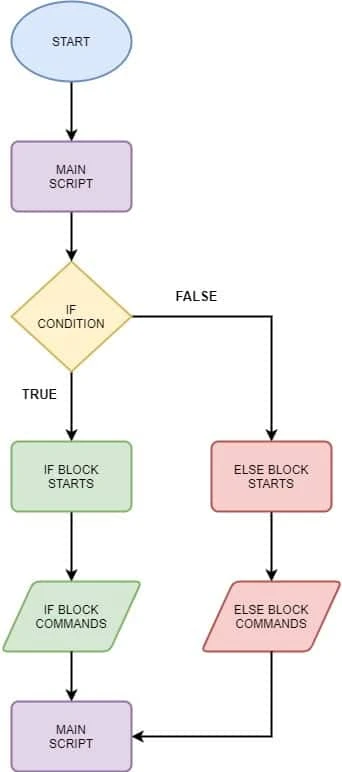
Python if else statement
Python Script Example
- We will continue to use our existing example, and we will add one
additional
else block - Observe the indentation, once the
if blockends, we switch back to the starting of line where theif blockhad started. - Both
ifandelsecondition should start at the same point of line - Next provide indentation of all the statements in the
else blocksimilar toif block - Now if the provided number is greater than 5, then the if condition
returns
Trueand theif blockwill be called. - But if the provided number is less than 5, then if condition returns
Falseand theelse blockwill be executed - The last
printstatement i.e. “Now we are in main function” will be called irrespective of the condition value because it is called outside theif..elseblock
#!/usr/bin/env python3

import sys

# Only integers allowed
try:
    num = int(input("Enter any number: "))
except:
    print("Only numbers allowed")
    sys.exit(1)

# if block condition
if num > 5:
    # if block starts, notice the indentation
    print("You have entered the if block")
    print("The provided number is greater than 5")
    print("Exiting if block")
# else block
else:
    # else block starts, notice the indentation
    print("You have entered the else block")
    print("The provided number is less than 5")
    print("Exiting else block")

# if..else block ends, notice the indentation
print("Now we are in main function")
Output (if condition returns True):
# python3 /tmp/if_else_example.py
Enter any number: 6
You have entered the if block
The provided number is greater than 5
Exiting if block
Now we are in main function
Output (if condition returns False):
# python3 /tmp/if_else_example.py
Enter any number: 4
You have entered the else block
The provided number is less than 5
Exiting else block
Now we are in main function
Python if..elif..else statement
It is possible that we have more than 2 conditions, in such case we can
use if..elif..else condition.
Syntax
The syntax to use if..elif..else statement would be:
if condition-1:
    sequence of statements-1
elif condition-n:
    sequence of statements-n
else:
    default sequence of statements
- Here, in the syntax, we are illustrating a series of branching statements under different conditions which is also called conditional branching in any language.
- First, we encounter an
if blockand if the condition inside theif blockis satisfied or becomesTrue, only then will theif blockbe executed. - If while executing the condition inside the
if blockis not satisfied i.e. returnsFalse, then the control is handed over to the immediate condition statement, that is,elif block, where the condition would be checked differently - Finally, we have the
else block, where if all the conditions before theelsecondition fail, then theelse blockwill process the code.
Flowchart
The syntax is explained in the form of a flowchart with single
if..elif..else statement
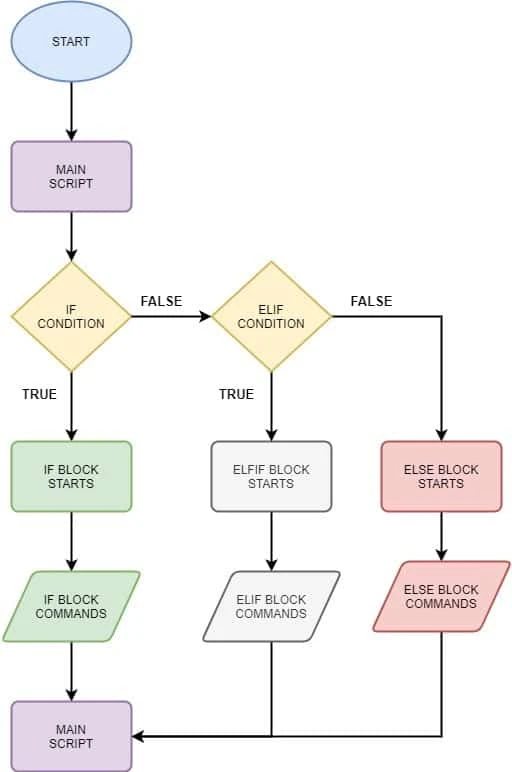
Python if elif else statement
Python Script Example
- We will continue to use our existing example, and we will add one
elif blockbetweenif..else block - In our
elif blockwe add a condition to check if provided number is equal to 5. If this returnsTruethen theelif blockwill be executed - If both
ifandelif blockreturnsFalsethen theelse blockwill be executed - The last
printstatement i.e. “Now we are in main function” will be called irrespective of the condition value because it is called outside theif..elif..else block
#!/usr/bin/env python3

import sys

# Only integers allowed
try:
    num = int(input("Enter any number: "))
except:
    print("Only numbers allowed")
    sys.exit(1)

# if block condition
if num > 5:
    # if block starts, notice the indentation
    print("You have entered the if block")
    print("The provided number is greater than 5")
    print("Exiting if block")
elif num == 5:
    # elif block starts, notice the indentation
    print("You have entered the elif block")
    print("The provided number is equal to 5")
    print("Exiting elif block")
else:
    # else block starts, notice the indentation
    print("You have entered the else block")
    print("The provided number is less than 5")
    print("Exiting else block")

# if..elif..else block ends, notice the indentation
print("Now we are in main function")
Output (if condition for if block returns True):
# python3 /tmp/if_else_example.py
Enter any number: 6
You have entered the if block
The provided number is greater than 5
Exiting if block
Now we are in main function
Output (if condition for elif block returns True):
# python3 /tmp/if_else_example.py
Enter any number: 5
You have entered the elif block
The provided number is equal to 5
Exiting elif block
Now we are in main function
Output (if condition for both if and elif block returns False):
# python3 /tmp/if_else_example.py
Enter any number: 4
You have entered the else block
The provided number is less than 5
Exiting else block
Now we are in main function
Python Nested if statement
We can add nested if..elif..else statement inside
if..elif..else blocks. The existing syntax which I showed above can be
used, the only important point to note is that you must use proper
indentation within the blocks or else you may get indentation error
Python Script Example
- Let us use our existing example, I will add nested
if..elif..else blockinside theelse block - The first
if conditionchecks if the provided number is less than 5 or else returnsFalse - The
elif conditionchecks if the provided number is equal to 5, if this returnsFalsethenelse blockis executed - Inside
else blockwe had addednested if..elif..else condition - So if num is equal to 1 then
nested if blockwill be executed, if this returnsFalsethennested if..elif blockwill be executed. lastly if bothnested if..elifreturnsFalsethen thenested if..elif..else blockwill be executed - The last
printstatement i.e. “Now we are in main function” will be called irrespective of the condition value because it is called outside the if..elif..else block
#!/usr/bin/env python3

import sys

# Only integers allowed
try:
    num = int(input("Enter any number: "))
except:
    print("Only numbers allowed")
    sys.exit(1)

# if block condition
if num > 5:
    # if block starts, notice the indentation
    print("You have entered the if block")
    print("The provided number is greater than 5")
    print("Exiting if block")
elif num == 5:
    # elif block starts, notice the indentation
    print("You have entered the elif block")
    print("The provided number is equal to 5")
    print("Exiting elif block")
else:
    # else block starts, notice the indentation
    print("You have entered the else block")
    if num == 1:
        # nested if block starts, notice the indentation
        print("You have entered into nested if block")
        print("The provided number is equal to 1")
        print("Exiting nested if block")
    elif num == 2:
        # nested if..elif block starts, notice the indentation
        print("You have entered into nested if..elif block")
        print("The provided number is equal to 2")
        print("Exiting nested if..elif block")
    else:
        # nested if..elif..else block continues, notice the indentation
        print("The provided number is less than 5")
        print("Exiting nested if..elif..else block")

# if..elif..else block ends, notice the indentation
print("Now we are in main function")
Output (if condition for nested if block returns True):
# python3 /tmp/if_else_example.py
Enter any number: 1
You have entered the else block
You have entered into nested if block
The provided number is equal to 1
Exiting nested if block
Now we are in main function
Output (if condition for nested if block returns False and
nested if..elif block returns True):
# python3 /tmp/if_else_example.py
Enter any number: 2
You have entered the else block
You have entered into nested if..elif block
The provided number is equal to 2
Exiting nested if..elif block
Now we are in main function
Output (if condition for both nested if and nested if..elif block
returns False):
# python3 /tmp/if_else_example.py
Enter any number: 3
You have entered the else block
The provided number is less than 5
Exiting nested if..elif..else block
Now we are in main function
Python logical operator with if condition
In the if condition, you can define multiple conditions using python
logical operators. Use logical and, or, not operator in your
python scripts to define multiple condition. These operators can be used
with if or elif condition
In all the syntax I shared above, replace condition with
- For and operator:
condition-1 and condition-2 - For or operator:
condition-1 or condition-2 - For not operator:
not condition
Python Script Example-1
- In this example I will use
andoperator withif conditionandoroperator withelif condition block - The first
if conditionchecks if num is greater than 5andless than 10 using and operator - The second
elif conditionchecks if num is equal to 4or5 using or operator - The last
printstatement i.e. “Now we are in main function” will be called irrespective of the condition value because it is called outside theif..elif..else block
#!/usr/bin/env python3

import sys

# Only integers allowed
try:
    num = int(input("Enter any number: "))
except:
    print("Only numbers allowed")
    sys.exit(1)

# if block condition
if num > 5 and num < 10:
    # if block starts, notice the indentation
    print("You have entered the if block")
    print("The provided number is greater than 5 and less than 10")
    print("Exiting if block")
elif num == 4 or num == 5:
    # elif block starts, notice the indentation
    print("You have entered the elif block")
    print("The provided number is equal to 4 or 5")
    print("Exiting elif block")
else:
    # else block starts, notice the indentation
    print("You have entered the else block")
    print("The provided number is less than 5")
    print("Exiting else block")

# if..elif..else block ends, notice the indentation
print("Now we are in main function")
Output (if and operator from if condition returns True)
# python3 /tmp/if_else_example.py
Enter any number: 6
You have entered the if block
The provided number is greater than 5 and less than 10
Exiting if block
Now we are in main function
Output (if or operator from elif condition returns True)
# python3 /tmp/if_else_example.py
Enter any number: 4
You have entered the elif block
The provided number is equal to 4 or 5
Exiting elif block
Now we are in main function
Python Script Example-2
- In this example I will use the logical
notoperator. - When the
if conditionreturnsTruei.e. if num isnotgreater than 5 thenif blockwill be executed - If the
if blockreturnsFalsei.e. if num is greater than 5 thenelse blockwill be executed - The last
printstatement i.e. “Now we are in main function” will be called irrespective of the condition value because it is called outside theif..elseblock
#!/usr/bin/env python3

import sys

# Only integers allowed
try:
    num = int(input("Enter any number: "))
except:
    print("Only numbers allowed")
    sys.exit(1)

# if block condition
if not num > 5:
    # if block starts, notice the indentation
    print("You have entered the if block")
    print("The provided number is less than 5")
    print("Exiting if block")
else:
    # else block starts, notice the indentation
    print("You have entered the else block")
    print("The provided number is greater than 5")
    print("Exiting else block")

# if..else block ends, notice the indentation
print("Now we are in main function")
Output(if not operator from if condition returns True)
# python3 /tmp/if_else_example.py
Enter any number: 3
You have entered the if block
The provided number is less than 5
Exiting if block
Now we are in main function
Output(if not operator from if condition returns False)
# python3 /tmp/if_else_example.py
Enter any number: 6
You have entered the else block
The provided number is greater than 5
Exiting else block
Now we are in main function
Conclusion
In this tutorial we learned about if..elif..else statement used in Python programming
language. Along with these condition you can use
string comparison operators
or logical operators such as and, or, not for comparison. The
respective condition block will be executed based on their exist status.
The True boolean represents zero exit status while the False boolean
represents non-zero exit status. Lastly I hope this tutorial guide on
python if else statement was helpful. So, let me know your suggestions
and feedback using the comment section.