
![git diff usage explained [Multiple Scenarios]](/git-diff-examples/git_diff.jpg)
Introduction to git diff
A diff function is a command-line tool that displays the differences in
outputs of two data sources in a git environment. Git diff command
helps to show a comparison between files, branches, tags and commits
that make up a commit-tree. It can bring out the distinction between
various versions of commits history and therefore a powerful tool to use
in monitoring the project progress. Diff function is supported by the
git log and the git status command when it comes to maintaining the
status updates.
Among the changes you can monitor using diff function include differences between a merge, differences between two trees, differences between the index and active tree among others.
In this tutorial, we shall explain different scenarios for working with
git diff using examples.
Git diff workflow
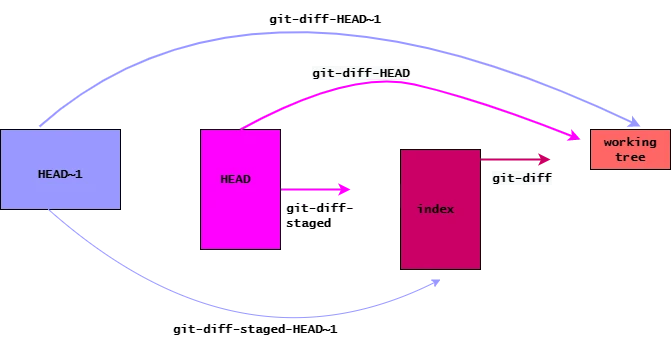
git diff workflow
The above image is a simplified illustration of how the git diff command works as summarized below;
git-diff-HEAD~1is the distinction betweenHEAD~1and the working tree.git-diff–HEADis the difference betweenHEADand the working tree.git-diff-stagedis the distinction between the HEAD and the index.- The difference between
HEAD~1andindexisgit-diff-staged-HEAD~1 git–diffis the difference between the index and working tree.
git diff syntax
You can use git diff along with following supported options. To get more details on individual supported options, you can refer official git documentation:
git diff [<options>] [<commit>] [--] [<path>…]
git diff [<options>] --cached [--merge-base] [<commit>] [--] [<path>…]
git diff [<options>] [--merge-base] <commit> [<commit>…] <commit> [--] [<path>…]
git diff [<options>] <commit>…<commit> [--] [<path>…]
git diff [<options>] <blob> <blob>
git diff [<options>] --no-index [--] <path> <path>
Setting up the lab environment
To practice using the diff command, first, we will have to
set up the
lab environment. I will therefore clone the remote project
git-diff-c to my local workstation that I will be using for this
tutorial. I’m using windows 10 pro and git version 2.32.0.windows.2.
See below the expected output:
$ git clone https://github.com/J-Mulombi/git-diff-c.git
Cloning into 'git-diff-c'...
remote: Enumerating objects: 3, done.
remote: Counting objects: 100% (3/3), done.
remote: Total 3 (delta 0), reused 0 (delta 0), pack-reused 0
Receiving objects: 100% (3/3), done.
git diff examples
Scenario-1: Use git diff to track changes between the active local directory and the index
We will use git diff command to show the distinction between the
staged commits in the index and active directory.
In this example, we shall first
create a new
branch mybranch from the master branch in our git-diff-c local
repository as follows:
$ git checkout -b mybranch
Switched to a new branch 'newbranch'
Let’s now add two files test-1.txt and test-2.txt to the active branch
mybranch as shown below:
$ touch test-1.txt

$ touch test-2.txt

$ git add .
Next, we shall run the git status command to view the new files in
staging area as illustrated below:
$ git status
On branch newbranch
Changes to be committed:
  (use "git restore --staged <file>..." to unstage)
        new file:   .test-1.txt
        new file:   test-2.txt
After adding two files test-1.txt and test-2.txt to the active
branch mybranch, we shall proceed to modify both files.
$ echo "edited file" >> test-1.txt

$ echo "edited file" >> test-2.txt
Next, we shall run the git status command again to view test-2.txt
andtest-1.txt files unstaged as displayed below:
$ git status
Sample output:
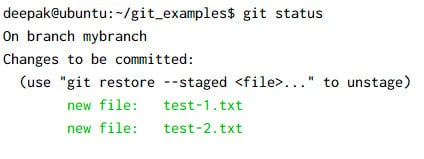
Notice from the above output both files test-1.txt and test-2.txt
have been modified, unstaged and waiting to be committed.
To illustrate how git diff shows the differences in the local directory
and the index, let’s again modify test-2.txt file at this stage. Then
we will proceed to run the diff command to see the difference.
$ echo "added first line in test-2 file" >> test-2.txt
Check the difference in the local repo:
$ git diff
Sample Output:
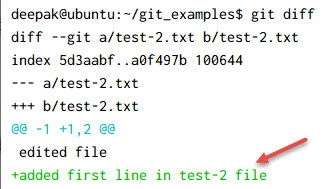
From the output, the diff command has displayed the distinction between
two versions of test-2.txt file located in the staging area.
Scenario-2: Apply diff command to track the differences between the active directory and the last commit
You can track changes between the last commit and the active directory as follows:
Let’s again make some changes to test-2.txt file before running the
diff command in this example.
To see the distinction between the active directory and our last commit,
we shall run the git diff HEAD command as illustrated below:
$ echo "added third line in test-2 file" >> test-2.txt

$ git diff HEAD
diff --git a/test-1.txt b/test-1.txt
new file mode 100644
index 0000000..5d3aabf
--- /dev/null
+++ b/test-1.txt
@@ -0,0 +1 @@
+edited file
diff --git a/test-2.txt b/test-2.txt
new file mode 100644
index 0000000..c88866e
--- /dev/null
+++ b/test-2.txt
@@ -0,0 +1,3 @@
+edited file
+added first line in test-2 file
+added third line in test-2 file
Sample Output:
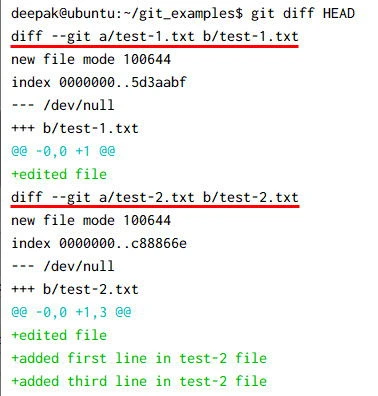
Note that the output shows the changes between the active repository and
the last commit. It shows the history of all commits when we first added
files test-1.txt and test-2.txt to the latest modification done to
the test-2.txt file.
Scenario-3: Use diff to track the difference between the staging area and the last commit
You can track the difference between the last commit and the staging area as follows:
In this example, we shall stage file test-3.txt that we had earlier
created and modified. So how do we track the differences between the
last commit and the staging area?
Here I have test-4.txt in the staging area while test-2.txt is
waiting for the commit:
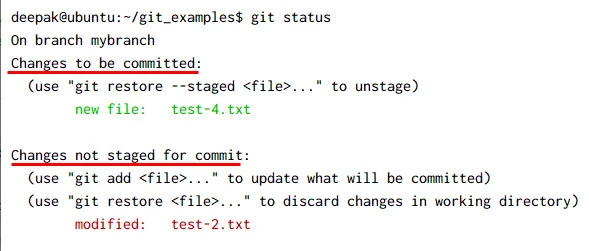
To track the differences between the last commit and staging area, run
the git diff --staged HEAD command as demonstrated below:
$ git diff --staged HEAD
diff --git a/test-4.txt b/test-4.txt
new file mode 100644
index 0000000..e69de29
According to the output, test-4.txt is a staged commit, and it is yet
to be committed. You can compare the output with git diff HEAD:
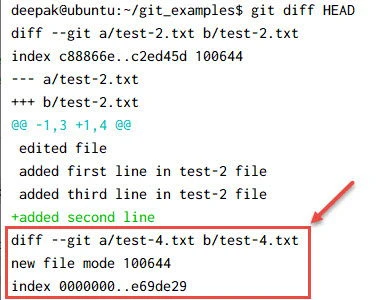
So we learned that:
git diff --stagedwill only show changes to files in the “staged” area.git diff HEADwill show all changes to tracked files. If you have all changes staged for commit, then both commands will output the same.
Scenario-4: Track the distinction between git commits using the diff operator
You can track the differences between two commits as shown below:
While on mybranch we shall run the git log --oneline command to see
all the commits.
$ git log --oneline
2ae9f25 (HEAD -> mybranch) edited file test-2.txt
9ec46d0 (origin/master, origin/HEAD, master) Initial commit
Next, we shall run the diff between commit 2ae9f25 and 9ec46d0.
$ git diff 2ae9f25 9ec46d0
diff --git a/test-1.txt b/test-1.txt
deleted file mode 100644
index e69de29..0000000
diff --git a/test-2.txt b/test-2.txt
deleted file mode 100644
index e69de29..0000000
The above results display the difference between commit 9ec46d0 and
the 9ec46d0``initial commit on the active branch mybranch.
Scenario-5: Use diff command to track the difference between git branches
To track the difference between git branches you shall run the
git diff <branch A> <branch B> commanded as illustrated below:
$ git diff master mybranch
diff --git a/test-1.txt b/test-1.txt
new file mode 100644
index 0000000..e69de29
diff --git a/test-2.txt b/test-2.txt
new file mode 100644
index 0000000..e69de29
The results display the commits differences between the master branch
and mybranch in the remote repository git-diff-c. This diff
information is vital, especially when working on a collaborated project
to manage conflicts.
Summary
We have been able to cover the following topics about diff function:
- The meaning of git function
- The git diff operator workflow
- Git function working scenarios