
![HackerRank Solution: Python Check Strict Superset [4 Methods]](/check-strict-superset-hackerrank-solution-python/python_check_strict_superset.jpg)
Question: Check Strict Superset [Python Sets]
You are given a setAandnother sets.
Your job is to find whether setAis a strict superset of each of
theNsets.
PrintTrue, ifAis astrict supersetof each of theNsets.
Otherwise, printFalse.
A strict superset has at least one element that does not exist in its subset.
Example
Set([1, 3, 4])is astrict supersetof set([1, 3]).
Set([1, 3, 4])is not astrict supersetof set([1, 3, 4]).
Set([1, 3, 4])is not astrict supersetof set([1, 3, 5]).
Input Format
The first line contains the space separated elements of setA.
The second line contains integern, the number of other sets.
The nextnlines contains the space separated elements of the other
sets.
Constraints
0 < len(set(A)) < 5010 < N < 210 < len(otherSets) < 101
Output Format
PrintTrueif setAis astrict supersetof all otherNsets.
Otherwise, printFalse.
Sample Input 0
1 2 3 4 5 6 7 8 9 10 11 12 23 45 84 78
2
1 2 3 4 5
100 11 12
Sample Output 0
False
Explanation 0
SetAis thestrict supersetof the set([1, 2, 3, 4, 5])but not of
the set ([100, 11, 12])because100is not in setA.
Hence, the output isFalse.
If you are new to python then I would recommend reading out Python Sets before attempting this question.
Possible Solutions
1. Using the issuperset Method
In this solution, we start by reading the elements of the main set and
converting them into a set of integers. We also read the number of other
sets. For each of these sets, we read the elements and convert them into
a set of integers inside
Python for loop. We then use the issuperset method to check if the
main set is a strict superset of each of the other sets. If the main set
is a strict superset of all other sets, we print True; otherwise, we
print False. This method uses the issuperset method for superset
checking.
# Read main set
main_set = set(map(int, input().split()))

# Read number of other sets
n = int(input())

is_strict_superset = True
for _ in range(n):
    other_set = set(map(int, input().split()))
    if not (main_set > other_set):  # Strict superset check
        is_strict_superset = False
        break

print(is_strict_superset)
2. Using All Function and Set Operations
In this solution, we begin by reading the elements of the main set and
converting them into a set of integers. We also read the number of other
sets. For each of these sets, we read the elements and convert them into
a set of integers. We then use a combination of the all function and
set operations to check if the main set is a strict superset of each of
the other sets. The result is printed as True if the main set is a
strict superset and False otherwise. This method uses the all
function for comprehensive checking.
# Read main set
main_set = set(map(int, input().split()))

# Read number of other sets
n = int(input())

other_sets = [set(map(int, input().split())) for _ in range(n)]

# Check if main set is a strict superset of all other sets
print(all(main_set > other_set for other_set in other_sets))
3. Using For Loop and Subset Checking
In this solution, we start by reading the elements of the main set and
converting them into a set of integers. We also read the number of other
sets. For each of these sets, we read the elements and convert them into
a set of integers. We then use a for loop to manually check if the
main set is a strict superset of each of the other sets using the >
operator. Based on the result, we print True if the main set is a
strict superset of all other sets and False otherwise. This method
uses a for loop and the > operator for checking.
# Read main set
main_set = set(map(int, input().split()))

# Read number of other sets
n = int(input())

is_strict_superset = True
for _ in range(n):
    other_set = set(map(int, input().split()))
    if not main_set > other_set:  # Strict superset check
        is_strict_superset = False
        break

print(is_strict_superset)
4. Using List Comprehension and All Function
In this solution, we begin by reading the elements of the main set and
converting them into a set of integers. We also read the number of other
sets. For each of these sets, we read the elements and convert them into
a set of integers. We then use list comprehension combined with
the all function to check if the main set is a strict superset of each
of the other sets. The result is printed as True if the main set is a
strict superset and False otherwise. This method uses list
comprehension and the all function for concise checking.
# Read main set
main_set = set(map(int, input().split()))

# Read number of other sets
n = int(input())

# Check if main set is a strict superset of all other sets using list comprehension and all function
print(all(main_set > set(map(int, input().split())) for _ in range(n)))
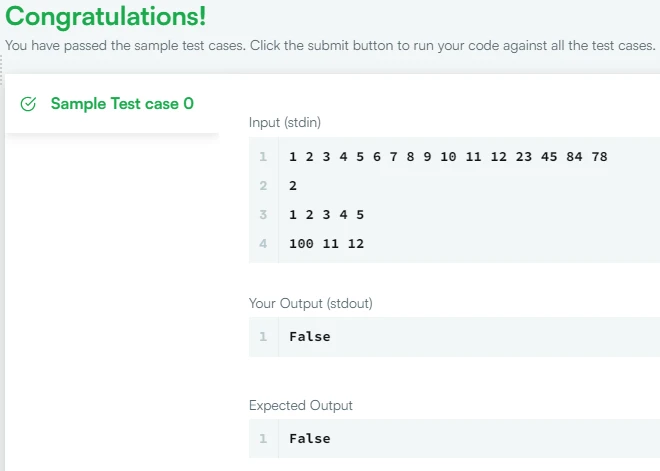
When we run the code from all three possible solutions on Hacker Rank, the sample Test case is shown as successful:
Summary
In this tutorial, we explained four possible solutions to solve
HackerRank’s Python problem on checking if a set is a strict superset of
other sets. The first solution uses the issuperset method to directly
check the superset relationship. The second solution employs the all
function combined with set operations for comprehensive checking. The
third solution uses a for loop with the > operator to manually
verify the superset relationship. The fourth solution utilizes list
comprehension and the all function for concise checking. Each method
demonstrates different Python techniques to efficiently solve the
problem.
Further Reading
Question on Hacker Rank: Python Check Strict Superset [Sets]